Here's an idea: Stand up against corruption.
Are you being railroaded by the North Carolina Railroad? Click on the link to learn what can happen when the North Carolina Railroad Knocks On Your Door.
Thursday, August 16, 2007
Sunday, August 05, 2007
Bora's interview with John Edwards
Don't miss Idea Consultant Bora's interview with John Edwards.
excerpt:

Benny and Markos
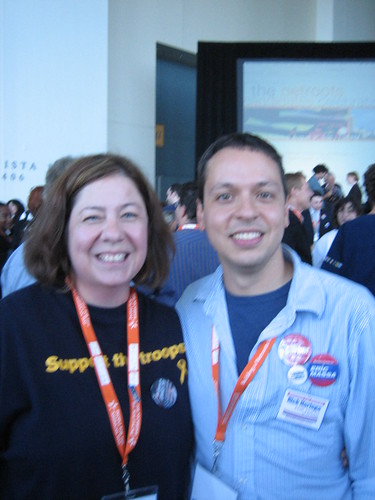
Benny attended the Yearly Kos convention this weekend and you can read her thoughts at Benny's World.
excerpt:
Q: If elected President, what can you do, and what you intend to do to reverse the anti-science trend seen in the USA over the past several years? What is your role as President to enhance public understanding of science and what can you do to ensure quality science education in all public schools in the country at all levels?
SEN EDWARDS: For the sake of our future, we need to start young. Our education system shortchanges the skills our children need for the future--math and science, creativity and critical thinking. Every day you can read reports about how we're falling behind in math and science--our 9th-graders are 18th in the world in science education. We need to invest in the next generation of math and science teachers for our schools. Ninety-five percent of urban high schools report problems getting qualified science teachers. We need higher pay for teachers, college loan forgiveness, and better teacher training programs.
We also need more kids going to college. I will create a national initiative called College for Everyone to pay one year of public-college tuition, fees, and books for more than 2 million students. If we are to compete in the new global economy we must emphasize science, engineering and other technical fields in our education system.
Q: In your opinion, what kind of healthcare system would be best poised to respond quickly and efficiently to threats such as avian flu or a bioterrorist attack, and what can a President do to enact such a radical change in the healthcare system?
SEN. EDWARDS: Right now, we are unprepared for a serious flu outbreak or bioterrorist attack. If such a crisis were to unfold--God forbid--think about what would happen. To start, some people may not even go to the hospital because they don't have health care. 45 million of us lack basic health care. Those who do go would probably go directly to emergency rooms, which are overcrowded and understaffed. Doctors and nurses in these emergency rooms are often forced to treat these patients without proper patient medical records because of our failure to switch to electronic medical records. Finally, it is possible for hundreds of people to be the victims of an outbreak or attack without anyone ever connecting the dots. Currently, it takes several days for the government to learn about two key factors in any disease outbreak: the progression of the disease through different communities and the availability of vaccine to respond to the disease.
There are some immediate steps we can take to ensure that we are prepared for an outbreak or an attack. First, we need to ensure that people are willing to seek health care if they are sick because they are not worried about paying the bills. Second, we need to bring information technology to our entire health care system so that doctors and nurses who are treating patients have adequate medical records. Third, we need to establish a real-time, unified national tracking system for diseases and for vaccines. Such a system will be easily accessible to public health officials so they can learn how a disease is moving and where to get vaccines.
It's critical that we maintain a health care safety net that includes public hospitals, clinics, and community health centers. Public hospitals are critical for the valuable trauma and emergency care needed to respond to a public health crisis or bioterrorist attack.
On the federal level, we need better coordination. Over 200 government offices are potentially involved in responding, and I'm concerned that there is not an adequate national plan for coordination and leadership in the event of an epidemic or attack. It is the federal government's duty to ensure adequate stockpiles of vaccines and antibiotics and to help state and local governments become better prepared for a bioterrorist attack. The federal government also has the responsibility for agricultural and food inspections, which is a critical part of preventing potential public health crises. These are all issues I worked on in the Senate.
Benny and Markos
Benny attended the Yearly Kos convention this weekend and you can read her thoughts at Benny's World.

Friday, February 02, 2007
Big Plans for NC (and Triangle) Blogging in the New Year
So, whats' cookin' in the local blogging world? Quite a lot, actually.
First, our little group, BlogTogether is growing, growing. Instead of being just a little Anton's sideproject, we are thinking of turning it into a non-profit organization - so if you have experience with founding non-profits please let us know ASAP.
Also, apart from Anton, several others (including myself) are now able to post there. This will make the blog much more active and interactive this year than it was ever before. We are also looking for a nice-looking logo for it so we can slap it on side-bars of all of our blogs. If you have talent, give it a try!
Second, we are much more ambitious with meet-ups this year. We plan on having, each month, one virtual meet-up (here). We'll continue with our regular two meet-ups (at Milltown at 6:30pm) where we sit down over coffee or beer and chat, usually starting with a particular topic (see here for some topics we are planning for February and March), before it becomes a free-for-all. Even if you are not a blogger - come by and within minutes you'll have a blog of your own as we'll help you set one up in minutes!
Once a month we'll have a more active meet-up, actually doing something fun for a change (and get our butts off the comfortable chairs). This month, we'll go bowling (hey, the place has wi-fi, so you can liveblog!). In the past, we've had between four and eight people normally showing up at meetups (unless a celebrity comes by - then everyone shows up). Let's try to have a greater attendance this year. After all, now that both Pandagon (with both Pam and Amanda living here) and Panda's Thumb are Triangle-based blogs (should our logo have a panda on it?!), the epicenter of power-blogging of the world is somewhere in the RTP area, I'd guess. So come by and meet the blogging stars!
We are already planning the second Science Blogging Conference (and the anthology to go with it) for early 2008!
In the meantime, think about joining us for the FoodBlogging series of events (if eating, drinking, eating, drinking and repeating it all over again can be called 'events') this summer. Sure, click on that link and salivate! What great places to eat and drink with fellow bloggers and blog about it!
Anton is hinting about some major activity on the StoryBlogging front this year as well.
And there are more ideas floating around (a design conference, perhaps an EduBlogging Conference, etc.)
Finally, and very importantly, the Tar Heel Tavern #102 will be hosted at Moomin Light this weekend. There is no theme, so send whatever you'd like to: songfinn AT yahoo DOT com by Saturday evening..
Once again, the Tavern was closed last weekend for the lack of a host. Will #102 be the last Tarheel Tavern? It's up to you - no one is signed up to host after this weekend. Do you want to host in the near future? Let us know. Do you want to get more involved in managing the carnival (as Laurie, Erin and I are both too busy with other stuff to do so full-time)? In any case, let us know at: coturnix AT gmail DOT com (me) or lponeill AT att DOT net (Laurie).
First, our little group, BlogTogether is growing, growing. Instead of being just a little Anton's sideproject, we are thinking of turning it into a non-profit organization - so if you have experience with founding non-profits please let us know ASAP.
Also, apart from Anton, several others (including myself) are now able to post there. This will make the blog much more active and interactive this year than it was ever before. We are also looking for a nice-looking logo for it so we can slap it on side-bars of all of our blogs. If you have talent, give it a try!
Second, we are much more ambitious with meet-ups this year. We plan on having, each month, one virtual meet-up (here). We'll continue with our regular two meet-ups (at Milltown at 6:30pm) where we sit down over coffee or beer and chat, usually starting with a particular topic (see here for some topics we are planning for February and March), before it becomes a free-for-all. Even if you are not a blogger - come by and within minutes you'll have a blog of your own as we'll help you set one up in minutes!
Once a month we'll have a more active meet-up, actually doing something fun for a change (and get our butts off the comfortable chairs). This month, we'll go bowling (hey, the place has wi-fi, so you can liveblog!). In the past, we've had between four and eight people normally showing up at meetups (unless a celebrity comes by - then everyone shows up). Let's try to have a greater attendance this year. After all, now that both Pandagon (with both Pam and Amanda living here) and Panda's Thumb are Triangle-based blogs (should our logo have a panda on it?!), the epicenter of power-blogging of the world is somewhere in the RTP area, I'd guess. So come by and meet the blogging stars!
We are already planning the second Science Blogging Conference (and the anthology to go with it) for early 2008!
In the meantime, think about joining us for the FoodBlogging series of events (if eating, drinking, eating, drinking and repeating it all over again can be called 'events') this summer. Sure, click on that link and salivate! What great places to eat and drink with fellow bloggers and blog about it!
Anton is hinting about some major activity on the StoryBlogging front this year as well.
And there are more ideas floating around (a design conference, perhaps an EduBlogging Conference, etc.)
Finally, and very importantly, the Tar Heel Tavern #102 will be hosted at Moomin Light this weekend. There is no theme, so send whatever you'd like to: songfinn AT yahoo DOT com by Saturday evening..
Once again, the Tavern was closed last weekend for the lack of a host. Will #102 be the last Tarheel Tavern? It's up to you - no one is signed up to host after this weekend. Do you want to host in the near future? Let us know. Do you want to get more involved in managing the carnival (as Laurie, Erin and I are both too busy with other stuff to do so full-time)? In any case, let us know at: coturnix AT gmail DOT com (me) or lponeill AT att DOT net (Laurie).
Friday, January 26, 2007
Microphilanthropy: Help Mike Young
Dear friends and readers,
I am trying to help my friend Carolyn pay the mounting bills, and ease the worry that comes with her philanthropy. They are only asking one or two dollars, but certainly if you can give more, I'm sure that would truly make their day. Lord knows they coul use some surprises...
I'll just let Mike share his story:
Please give what you can.
-Dave
I am trying to help my friend Carolyn pay the mounting bills, and ease the worry that comes with her philanthropy. They are only asking one or two dollars, but certainly if you can give more, I'm sure that would truly make their day. Lord knows they coul use some surprises...
I'll just let Mike share his story:
I'm Mike Young
I am 46 years old. I am Mentally Challenged because of a hunting accident when I was 14 years old. I was shot in the head
and spent over a year in the hospital. During my recovery I underwent many surgeries and rehabilitative therapies.
I have lived and been cared for by my Aunt Carolyn since 1995 and she does a GREAT job. My mom and dad passed away within months of each other. My mom, on her death bed asked her sister (Aunt Carolyn) to care for me before she died. Being close sisters and always there for each other my aunt Carolyn did not think twice about saying
yes. With hardly any financial support she has been taking care of me.
Please give what you can.
-Dave
Tuesday, January 16, 2007
Science Blogging Anthology is here!
The first of its kind, phenomenal, unbelievable collection of the best science blogging in history has just been published!
Timed to coincide with the first Science Blogging Conference, this anthology of best 50 blog posts from science and medical blogs is now available for sale. You can find all the information about the book, including the blog-typical democratic process of choosing 50 best posts of all time, at this URL
I would really appreciate it if you could steer your readers towards it!
You can buy the book here.
Timed to coincide with the first Science Blogging Conference, this anthology of best 50 blog posts from science and medical blogs is now available for sale. You can find all the information about the book, including the blog-typical democratic process of choosing 50 best posts of all time, at this URL
I would really appreciate it if you could steer your readers towards it!
You can buy the book here.
Tuesday, January 02, 2007
Science Blogging Conference Update
 The conference is only 19 days from today! It's getting really exciting!
The program is shaping really well:
On Thursday (January 18th) we will have a teach-in session. About 20 people have signed up so far. We'll use Wordpress to help them start their own blogs, so I'll have to make one of my own in advance and play around to figure out the platform before I teach others.
On Friday (January 19th), we'll have dinner and all the bloggers present will read their posts. We have not decided on the place yet, but perhaps a site that has wifi, or a screen and a projector would be good as the posts can be seen as well as heard.
On Saturday (January 20th), we'll have a busy program. We have two speakers: a scientist - Hunt Willard (director of the Duke Insitute for Genome Sciences & Policy) and a science blogger - Janet Stemwedel (Adventures in Ethics And Science).
Then, we'll have four (or five) break-out sessions in an Unconference format - the participants take the lead and the leaders guide and moderate.
We decided not to have these sessions cover different areas of science, but different ways blogs, podcasts and other internet technologies can be used: a) research (e.g., using a blog as a public lab-notebook, online publishing), b) teaching (using the online technologies in the classroom), c) popularization of science (how to blog well, including the importance of visual props - illustration) and d) informing the public (e.g., public health, medicine, countering un-scientific forces in the society, etc. perhaps broken into wo sessions: one on science, one on medicine and public health). We have lined up four excellent people to moderate these sessions (not everything is on the wiki-page yet but will be soon).
Afterwards, we will go to dinner. If you have registered already, or plan to register soon, please do not forget to sign up for one of the dinners. Just edit the wiki and enter your name where you want.
At this moment we have 109 people registered for the conference. Some locals will probably sign up at the last minute. Some of the people coming from very far away may still be waiting for good deals on plane tickets before they sign up. If you are considering this, it would be good if you could sign up as soon as possible so we have a good idea how many people to plan for in terms of space, food, swag, etc.
If you browse through the list of registrants, you will see what a great diversity of people there will be, a potential for cross-fertilization leading to high hybrid vigor! There are people from four continents coming to Chapel Hill in January to meet with us, as well as people from a number of States. There are science, medical and technology bloggers, web-designers, research scientists working in academia, government and industry, physicians, postdocs, graduate and undergraduate students, even high school students. There will be editors of science and medical journals and magazines, journalism professors and students, local journalists, and science writers. There will be science teachers at all levels - elementary, middle, high school and college. There will be local elected officials, and staff of state departments. And, I hope, you will be there as well!
We have attracted quite a lot of cool sponsors for the conference, so you can excpect some really good stuff in your swag bags! Still, both Anton and I are quite bad at begging for money. We do need a little bit more - can you or your organization be a sponsor, or donor, or host? If so, let Anton know as soon as possible.
And we may just be able to pull it off to have the Anthology ready to be distributed at the conference.
Technorati Tag: sciencebloggingconference
Monday, December 11, 2006
I Searched For An Idea And It Found Me
Search engines are great tools. Blogs are great tools. But both have their short comings. You see, you can't easily control most search engines so that you limit them to only the types of results you want to get. Take Google for instance: a search for the word, "poet" brings up any number of listings but look at the #4 listing. It's a software company that has absolutely nothing to do with poetry.
And what's wrong with the first and second listings? They're both the same website. And coming in at #3 is dear old Wikipedia. Look, I like Wikipedia, I use it daily but it's predicted that at Wikipedia's current rate of growth Wikipedia may well become the #1 result for every single query in all of the major databases sometime in the next two years. The first actual listing of a real live poet comes in at #20, the second at #42. That would be Billy Jones of BloggingPoet.com. (Yes, that is your's truly.) So why is it the #1 and #2 poets on the Internet today are placed #20 and #42 in a Google search for the word, "poet?"
Note: Search engine results change often, a few months ago I was #1, last month I was #5 and next month I might not even be on the radar.
Now, let's move on to blogs, shall we. Blogs are great, I love 'em, they help build communities, and they're fun, but most blogs are all about one person, that being the author of that blog. No matter what the purpose or the context, most blogs are still about an individual. Not that there's anything wrong with that but I'm thinking there has to be more.
So I came up with two blogs that combine search and blogging limited to certain topics, the first being BloggingPoet411.com and the second being Blogsboro411. Unlike search engines, I can control what websites are listed in either database. BloggingPoet411.com is a database of poetry bloggers and Blogsboro411 is a listing of bloggers who live in the 11 county Piedmont Triad area of North Carolina. The bloggers submit their blogs along with their bios and anything else they consider to be their passions be it their business, volunteer efforts, personal info or anything in-between.
A similar project limited to 100 entries in each category is Bessed.com. Any listing can be added to Bessed.com, the only questions are how will they list you, will your listing remain in their top 100, or will you be deleted from their database?
Oh sure, human edited search is nothing new, the Open Directory Project has been around for years. I use Open Directory to power two search applications, Poetsarus.com and Blogels.com but you won't find my websites listed in either one. You see, despite the fact that I've 3 books in print (two of them poetry books) have no less than 3 novels online, post poetry online every single day, and edit Poets101.com-- the world's first and only full-featured poetry aggregator-- the "editors" at Open Directory have never bother to accept my application as a poet. Their editors consider my blogs to be personal websites when the one topic I shy away from is blogging about my personal life. And have you ever tried to get your own listing at Wikipedia? Did I mention I'm the #2 poet on the Internet today?
Look, I'm not mad, I just decided to do something about it and so can you. Is there a subject you specialize in? If so then why not own a piece of it? Odds are we'll not see another Google, Yahoo, or MSN emerge in our lifetimes but the niches are out there for those of you who desire to fill them for fun and for profit.
And what's wrong with the first and second listings? They're both the same website. And coming in at #3 is dear old Wikipedia. Look, I like Wikipedia, I use it daily but it's predicted that at Wikipedia's current rate of growth Wikipedia may well become the #1 result for every single query in all of the major databases sometime in the next two years. The first actual listing of a real live poet comes in at #20, the second at #42. That would be Billy Jones of BloggingPoet.com. (Yes, that is your's truly.) So why is it the #1 and #2 poets on the Internet today are placed #20 and #42 in a Google search for the word, "poet?"
Note: Search engine results change often, a few months ago I was #1, last month I was #5 and next month I might not even be on the radar.
Now, let's move on to blogs, shall we. Blogs are great, I love 'em, they help build communities, and they're fun, but most blogs are all about one person, that being the author of that blog. No matter what the purpose or the context, most blogs are still about an individual. Not that there's anything wrong with that but I'm thinking there has to be more.
So I came up with two blogs that combine search and blogging limited to certain topics, the first being BloggingPoet411.com and the second being Blogsboro411. Unlike search engines, I can control what websites are listed in either database. BloggingPoet411.com is a database of poetry bloggers and Blogsboro411 is a listing of bloggers who live in the 11 county Piedmont Triad area of North Carolina. The bloggers submit their blogs along with their bios and anything else they consider to be their passions be it their business, volunteer efforts, personal info or anything in-between.
A similar project limited to 100 entries in each category is Bessed.com. Any listing can be added to Bessed.com, the only questions are how will they list you, will your listing remain in their top 100, or will you be deleted from their database?
Oh sure, human edited search is nothing new, the Open Directory Project has been around for years. I use Open Directory to power two search applications, Poetsarus.com and Blogels.com but you won't find my websites listed in either one. You see, despite the fact that I've 3 books in print (two of them poetry books) have no less than 3 novels online, post poetry online every single day, and edit Poets101.com-- the world's first and only full-featured poetry aggregator-- the "editors" at Open Directory have never bother to accept my application as a poet. Their editors consider my blogs to be personal websites when the one topic I shy away from is blogging about my personal life. And have you ever tried to get your own listing at Wikipedia? Did I mention I'm the #2 poet on the Internet today?
Look, I'm not mad, I just decided to do something about it and so can you. Is there a subject you specialize in? If so then why not own a piece of it? Odds are we'll not see another Google, Yahoo, or MSN emerge in our lifetimes but the niches are out there for those of you who desire to fill them for fun and for profit.
Sunday, September 24, 2006
Call for Action - Free The Tripoli Six!
Five Bulgarian nurses and a Palestinian doctor have been wrongfully charged and are awaiting execution by firing squad in Libya for allegedly infecting children with HIV. They were tortured and forced to sign "confessions" written in Arabic they did not understand. In fact, the poor hygiene and bad practices in the hospital are to blame.
You can get more information in Nature (free access) editorial and news report and even more detail in an official report (pdf) and a letter (pdf) to Qaddafi.
What can you do?
First, ask your congresscritters what are they going to do about this - are they going to put international pressure on Libya to release the prisoners?
Second, e-mail your story to friends and, if you have a blog, write a post about this. Make sure that you have the words "Tripoli Six" in your post so that it gets picked up by Connotea, Technorati and Google blogsearch engines. Update: For Google (and Google News) you can also use "Benghazi Six" as well as "Tripoli Six".
You can also see what my SciBlings have written about it so far.
More information and commentary:
Saratoga Spirit
Declan Butler
Pharyngula
Method
Thoughts In A Haystack
Gene Expression
Stranger Fruit
Effect Measure
Deltoid
Adventures in Ethics and Science
Dr. Joan Bushwell's Chimpanzee Refuge
Pure Pedantry
Respectful Insolence
Aetiology
Uncertain Principles
The Questionable Authority (the best source of action/contact information)
Science Ripsaw
Firedoglake
LeftWorld
DailyKos
The World's Fair
Majikthise
Terra Sigillata
Open Reading Frame
Maya's Corner
Maya's Corner
Maya's Corner
Tinkerty Tonk
Thoughts From Kansas
Ovidio
Cyberspace Rendezvous
Effect Measure
Lingual Tremors
Crooked Timber
Cosmic Variance
BlinkBits
Nascent
Malaysian Medical Resources
Serialdeviant
Paeonia
Bouphonia
Alternet PEEK
Update: Revere and Lindsay now report that the Tripoli Six story has spread from science blogosphere to both Left and Right political blogs, ranging from DailyKos to Instapundit (gosh, even Free Republic!). This is certainly not just a science/medicine issue, and is certainly not a partisan issue - it is a matter of saving innocent lives!
Declan Butler, who has been on top of this, has already collected 82 blog links on Connotea and is working on the next step - getting the MSM to place this story on front pages. Can you help? Blogswarm this story by blogging about this, or blogging about this again, and again. Urge your readers to peruse this list of contact information and ask the congrescritters to pay attention and do something. If you know anyone in the MSM, hound them to write about this. This is not about the self-congratulatory pat-on-the-back about the "power of the blogosphere" - it is about righting a wrong and saving innocent lives.
You can get more information in Nature (free access) editorial and news report and even more detail in an official report (pdf) and a letter (pdf) to Qaddafi.
What can you do?
First, ask your congresscritters what are they going to do about this - are they going to put international pressure on Libya to release the prisoners?
Second, e-mail your story to friends and, if you have a blog, write a post about this. Make sure that you have the words "Tripoli Six" in your post so that it gets picked up by Connotea, Technorati and Google blogsearch engines. Update: For Google (and Google News) you can also use "Benghazi Six" as well as "Tripoli Six".
You can also see what my SciBlings have written about it so far.
More information and commentary:
Saratoga Spirit
Declan Butler
Pharyngula
Method
Thoughts In A Haystack
Gene Expression
Stranger Fruit
Effect Measure
Deltoid
Adventures in Ethics and Science
Dr. Joan Bushwell's Chimpanzee Refuge
Pure Pedantry
Respectful Insolence
Aetiology
Uncertain Principles
The Questionable Authority (the best source of action/contact information)
Science Ripsaw
Firedoglake
LeftWorld
DailyKos
The World's Fair
Majikthise
Terra Sigillata
Open Reading Frame
Maya's Corner
Maya's Corner
Maya's Corner
Tinkerty Tonk
Thoughts From Kansas
Ovidio
Cyberspace Rendezvous
Effect Measure
Lingual Tremors
Crooked Timber
Cosmic Variance
BlinkBits
Nascent
Malaysian Medical Resources
Serialdeviant
Paeonia
Bouphonia
Alternet PEEK
Update: Revere and Lindsay now report that the Tripoli Six story has spread from science blogosphere to both Left and Right political blogs, ranging from DailyKos to Instapundit (gosh, even Free Republic!). This is certainly not just a science/medicine issue, and is certainly not a partisan issue - it is a matter of saving innocent lives!
Declan Butler, who has been on top of this, has already collected 82 blog links on Connotea and is working on the next step - getting the MSM to place this story on front pages. Can you help? Blogswarm this story by blogging about this, or blogging about this again, and again. Urge your readers to peruse this list of contact information and ask the congrescritters to pay attention and do something. If you know anyone in the MSM, hound them to write about this. This is not about the self-congratulatory pat-on-the-back about the "power of the blogosphere" - it is about righting a wrong and saving innocent lives.
Monday, July 10, 2006

StreetPlanes Are Flying High
Here's my newest idea:
Advertise you website, blog, or business on the street with StreetPlanes. That's right, StreetPlanes-- airplanes that never leave the ground preferring instead to fly where the people are while pulling your banners for all to see. My website, BloggingPoet.com has been picking up over 200 new readers a day since I started using StreetPlanes and now you can too. Check out StreetPlanes.com and remember you heard about it right here at IdeaConsultants.org.
Advertise you website, blog, or business on the street with StreetPlanes. That's right, StreetPlanes-- airplanes that never leave the ground preferring instead to fly where the people are while pulling your banners for all to see. My website, BloggingPoet.com has been picking up over 200 new readers a day since I started using StreetPlanes and now you can too. Check out StreetPlanes.com and remember you heard about it right here at IdeaConsultants.org.
Wednesday, May 10, 2006
On Book Design
On Book Design by Richard Hendel - Communication Arts review.
Richard Hendel is an award-winning book designer from UNC-Chapel Hill.
Consistent Correlation Between Book Page and Type Area - by Jan Tschichold; selection from "The Form of the Book", essays by Jan Tschichold pub. by Lund Humphries 1991
Jeffery Keedy: Thoughts on Designing Type
"I am also inspired by type designers, their contribution as unique individuals, and how that manifests itself through their work. Designers like Dwiggins, Cooper, Goudy, Gill, Koch, Middleton, Excoffon, Novarese, Zapf, Carter, Unger, and Licko, would be on my short list."
Interview with Rudy VanderLans - Emigre
Richard Hendel is an award-winning book designer from UNC-Chapel Hill.
Consistent Correlation Between Book Page and Type Area - by Jan Tschichold; selection from "The Form of the Book", essays by Jan Tschichold pub. by Lund Humphries 1991
Jeffery Keedy: Thoughts on Designing Type
"I am also inspired by type designers, their contribution as unique individuals, and how that manifests itself through their work. Designers like Dwiggins, Cooper, Goudy, Gill, Koch, Middleton, Excoffon, Novarese, Zapf, Carter, Unger, and Licko, would be on my short list."
Interview with Rudy VanderLans - Emigre
Monday, May 08, 2006
Dancing to Cool Vblogs Being Piped Out
I don't know if this is happening, but I was thinking how MTV influenced many of us 25 years ago, and how their videos went into dance places (bars), but I think vblogs could do the same--and perhaps we can get some cool stuff out that way. What I don't know is how many still go out and get their ants pants out. I will find out.
Monday, April 17, 2006
Value of Social Networks
Today I received this e-mail about an author and his new book--in Cambridge, MA. To quote:
I thought some of you might be interested in this event featuring Yochai Benkler speaking about his new book:
Please join Harvard Law School's Berkman Center for Internet & Society on Tuesday evening for a short talk by Yochai Benkler, and then a celebration in his honor. Prof. Benkler has recently published his book, The Wealth of Networks: How Social Production Transforms Markets and Freedom," through the Yale University Press.
Prof. Benkler's research at Yale Law School focuses on the effects of laws that regulate information production and exchange on the distribution of control over information flows, knowledge, and culture in the digital environment. His particular focus has been the neglected role of commons-based approaches toward management of resources in the digitally networked environment, the increasing importance of nonmarket production in general and collaborative peer production in particular, and the significance of these phenomena in both economic and political terms.
The Wealth of Networks is a comprehensive social theory of the Internet and the networked information economy. In it, Benkler describes how patterns of information, knowledge, and cultural production are changing-and shows that the way information and knowledge are made available can either limit or enlarge the ways people can create and express themselves.
More information on the book (and ordering information) is available at
http://yalepress.yale.edu/yupbooks/book.asp?isbn=0300110561
and you may download it (parts and much more) on his wiki at http://www.benkler.org/wealth_of_networks/index.php/Main_Page.
Sounds interesting...Benny
I thought some of you might be interested in this event featuring Yochai Benkler speaking about his new book:
Please join Harvard Law School's Berkman Center for Internet & Society on Tuesday evening for a short talk by Yochai Benkler, and then a celebration in his honor. Prof. Benkler has recently published his book, The Wealth of Networks: How Social Production Transforms Markets and Freedom," through the Yale University Press.
Prof. Benkler's research at Yale Law School focuses on the effects of laws that regulate information production and exchange on the distribution of control over information flows, knowledge, and culture in the digital environment. His particular focus has been the neglected role of commons-based approaches toward management of resources in the digitally networked environment, the increasing importance of nonmarket production in general and collaborative peer production in particular, and the significance of these phenomena in both economic and political terms.
The Wealth of Networks is a comprehensive social theory of the Internet and the networked information economy. In it, Benkler describes how patterns of information, knowledge, and cultural production are changing-and shows that the way information and knowledge are made available can either limit or enlarge the ways people can create and express themselves.
More information on the book (and ordering information) is available at
http://yalepress.yale.edu/yupbooks/book.asp?isbn=0300110561
and you may download it (parts and much more) on his wiki at http://www.benkler.org/wealth_of_networks/index.php/Main_Page.
Sounds interesting...Benny
Tuesday, April 11, 2006
Idea Generation, Creativity, and Incentives
Columbia University researcher Olivier Toubia used an online discussion tree to devise an impact-based measure of how one idea in a group setting affects the generation of other ideas. That measure then served as the basis of an incentive system to reward individuals for stimulating ideas among other group members. An online test of the measure, with three groups of 26 members each, showed its value compared to two more common incentive methods.
The test asked the groups to generate ideas on the same problem — in this case, how to improve the United Nations Security Council. In the first group, everyone received the same flat fee. In the second group, your reward depended on how many ideas you contributed. In the third group, your reward depended on how many ideas other group members added to your ideas in the discussion tree.
The results showed that the third group generated more ideas overall, more different streams of ideas and ideas that were more fully articulated.
Read the rest here (text borrowed directly from Columbia's Ideas@Work).
Saturday, April 01, 2006
Ad-Busting Brain
From Seed Magazine:
Study shows that some words used in consumer branding only dig so deep into the brain.
by David Cohn • Posted March 22, 2006 11:48 AM
In news that must be distressing to advertisers spending an average of over $350,000 to produce a national 30 second commercial, a study examining the neural response to brand personality suggests that consumers aren't buying the hype.
snip
The finding indicates that the anthropomorphizing of brands often used in commercials isn't humanizing a product, and thus, the ad is falling on deaf ears.
Read the rest here.
It has implications for those who advertise on the Net.
I noticed that Seed is also advertising a Science Writing Contest--their first annual. This is intended to inspire writers to think critically about the state of science in America.
AD:
Amidst emerging competitive threats from abroad (China and India in particular) and heated debates over intelligent design, stem cells and climate change: What is the future of science in America? What should the US do to preserve and build upon its role as a leader in scientific innovation?
I bet readers and consultants on this blog could pen some great "overviews" and solutions on that topic. Winners get their essays published in the magazine and a little bit of cash.
Study shows that some words used in consumer branding only dig so deep into the brain.
by David Cohn • Posted March 22, 2006 11:48 AM
In news that must be distressing to advertisers spending an average of over $350,000 to produce a national 30 second commercial, a study examining the neural response to brand personality suggests that consumers aren't buying the hype.
snip
The finding indicates that the anthropomorphizing of brands often used in commercials isn't humanizing a product, and thus, the ad is falling on deaf ears.
Read the rest here.
It has implications for those who advertise on the Net.
I noticed that Seed is also advertising a Science Writing Contest--their first annual. This is intended to inspire writers to think critically about the state of science in America.
AD:
Amidst emerging competitive threats from abroad (China and India in particular) and heated debates over intelligent design, stem cells and climate change: What is the future of science in America? What should the US do to preserve and build upon its role as a leader in scientific innovation?
I bet readers and consultants on this blog could pen some great "overviews" and solutions on that topic. Winners get their essays published in the magazine and a little bit of cash.
Thursday, March 30, 2006
Reporting for Idea Duty
Hi! I'm Benny and I was graciously asked to join the Idea Consultants community. At the moment, I don't have a new idea to offer, but when I do, I will be blogging here!
Thanks, AnonyMoses for inviting me here, and I hope we can do some good work for the One America Committee (OAC) as I've been told by a couple of posters they would love to see some ideas generated by us and the Tar Heel Tavern folks.
Thanks, AnonyMoses for inviting me here, and I hope we can do some good work for the One America Committee (OAC) as I've been told by a couple of posters they would love to see some ideas generated by us and the Tar Heel Tavern folks.
Saturday, January 14, 2006
Podcastercon2006
Sorry for three days of absence from this blog. I needed some time to recuperate after the Podacstercon which I attended last Saturday. It was a marvelous experience. For more information check out the Podcastercon blog, the wiki, a nice article in News and Observer, the blog reports via Technorati tags, Technorati search and Google blogsearch and pictures on Flickr.
Kudos to Brian Russell for organizing an unconference and taking the concept to the maximum. All sessions were designed by participants by editing the wiki ahead of time. Some of the open sessions were designed on the spot! With at least half of the participants constantly online via their laptops, and two big screens in each of the two big classrooms, it was possible to make changes on the go and still be confident that all participants would be cognizant of the changes.
At one point someone asked "What are we supposed to do now?" and the next person answered "This is our conference. We'll do whatever we want. So, let's do something" That's the spirit! I did not see anyone uncomfortable with the free-flowing format. Everything that needed to happen happened and everyone was always in the loop.
The attendants, of course, are all used to the concept of swarming and connectivity and the order emerging out of chaos, so this worked perfectly for this kind of crowd. Still, if the conference gets bigger in the future (there were about 300 participants this time around, more than a third coming from out of state) and spreads over two days, perhaps a little bit more structure may be neccessary, but not too much more....
In the morning I attended The 411 - How to Podcast session. A little bit too non-linear and occasionally over my head (and I am a blogger, familiar with a lot of online stuff!), but I still managed to learn a lot or at least become familiar with some of the aspects of the process of making a podcast. Perhaps I should have gone to the Podcasting For Everyone open session in the afternoon - I heard it was better geared towards beginners (No, I do not regret attending the Podcasting and Traditional Media: Competition and Cooperation session - I have learned a lot about the radio business there).
First I need to chase down the tech-support guy to fix my sound card so I can do this. Then, guided by Brian's excellent Indy article, the book I got after the conference - Podcasting Hacks - also Podcasting For Dummies I just ordered, and the online tutorial Podcasting 101, I can get myself started on podcasting.
On a number of occasions in the past I've been frustrated when I wanted to include a paragraph or so from a source that is not available online (e.g., a book) in my blog posts. Mostly, I ignored it, sometimes I transcribed/retyped it, but in the future I plan to just read it into a microphone and embed an audio file into the post. How about a weekly podcast from James Dobson's childrearing books followed by my written commentary?
I met some extremely interesting people at the conference, as well as several bloggers I knew from before. We had dinner at Rathskeller and a beer at Fuse. It was a very valuable experience.
But the main reason I went to the Podcastercon was to attend the Education Session. It was worth it! David Warlick led the discussion. You can see his own comments, the workpage that was updated in real time during the session, and an excellent review by Teach42. There is so much material in all those places, there is no way I can summarize all of the session here, so just go and investigate by yourself.
What I want to do is record my lectures and have them available for students. I am teaching in March/April next time and I will definitely do this. But what was most interesting to me was the way this technology adapts to the psychology and sociology of today's students. As David stated in the beginning, today's students are extremely connected to each other. When they come into the classroom and are asked to switch off all of the electronic equipment (cell-phones, iPods, computers, etc.), we are cutting off their 'tentacles'. Now if I were a squid and someone cut off my tentacles I'd be very uncomfortable to say the least.
What the new technology does (and what freaks some people out) is that each student's work becomes public (not neccessarily to the wide world, but at least to other people within the school if the website is password-protected). In the past - and present - the only reader of the student's work is the teacher. In the future, all the work will be read, heard or seen by their peers. How is that going to shake the social organization of the classroom? Is that going to break down the traditional division into cliques of jocks, nerds, etc.? Is a popular jock going to be deflated when exposed to be a half-illiterate dummy, and a shy Goth girl in the corner becomes popular due to immense writing, speaking, acting or video-editing talents? Is the motivation going to rise for students to perform always their very best? I have asked similar questions regarding blogging in the classroom before. Is it going to have an effect like this?
That is why, I think, Fred Stuzman's work on The Facebook is so important (although it is a work on progress - he has done no stats yet, and I seriously doubt there is going to be a significant difference between # of friends that liberal and conservative students have, or the subtle changes in proportions of liberals and conservatives over time - it is only freshmen and only one semester so far, and a more longitudinal study is needed as I have stated before). What do you think?
Tag: podcastercon2006
Kudos to Brian Russell for organizing an unconference and taking the concept to the maximum. All sessions were designed by participants by editing the wiki ahead of time. Some of the open sessions were designed on the spot! With at least half of the participants constantly online via their laptops, and two big screens in each of the two big classrooms, it was possible to make changes on the go and still be confident that all participants would be cognizant of the changes.
At one point someone asked "What are we supposed to do now?" and the next person answered "This is our conference. We'll do whatever we want. So, let's do something" That's the spirit! I did not see anyone uncomfortable with the free-flowing format. Everything that needed to happen happened and everyone was always in the loop.
The attendants, of course, are all used to the concept of swarming and connectivity and the order emerging out of chaos, so this worked perfectly for this kind of crowd. Still, if the conference gets bigger in the future (there were about 300 participants this time around, more than a third coming from out of state) and spreads over two days, perhaps a little bit more structure may be neccessary, but not too much more....
In the morning I attended The 411 - How to Podcast session. A little bit too non-linear and occasionally over my head (and I am a blogger, familiar with a lot of online stuff!), but I still managed to learn a lot or at least become familiar with some of the aspects of the process of making a podcast. Perhaps I should have gone to the Podcasting For Everyone open session in the afternoon - I heard it was better geared towards beginners (No, I do not regret attending the Podcasting and Traditional Media: Competition and Cooperation session - I have learned a lot about the radio business there).
First I need to chase down the tech-support guy to fix my sound card so I can do this. Then, guided by Brian's excellent Indy article, the book I got after the conference - Podcasting Hacks - also Podcasting For Dummies I just ordered, and the online tutorial Podcasting 101, I can get myself started on podcasting.
On a number of occasions in the past I've been frustrated when I wanted to include a paragraph or so from a source that is not available online (e.g., a book) in my blog posts. Mostly, I ignored it, sometimes I transcribed/retyped it, but in the future I plan to just read it into a microphone and embed an audio file into the post. How about a weekly podcast from James Dobson's childrearing books followed by my written commentary?
I met some extremely interesting people at the conference, as well as several bloggers I knew from before. We had dinner at Rathskeller and a beer at Fuse. It was a very valuable experience.
But the main reason I went to the Podcastercon was to attend the Education Session. It was worth it! David Warlick led the discussion. You can see his own comments, the workpage that was updated in real time during the session, and an excellent review by Teach42. There is so much material in all those places, there is no way I can summarize all of the session here, so just go and investigate by yourself.
What I want to do is record my lectures and have them available for students. I am teaching in March/April next time and I will definitely do this. But what was most interesting to me was the way this technology adapts to the psychology and sociology of today's students. As David stated in the beginning, today's students are extremely connected to each other. When they come into the classroom and are asked to switch off all of the electronic equipment (cell-phones, iPods, computers, etc.), we are cutting off their 'tentacles'. Now if I were a squid and someone cut off my tentacles I'd be very uncomfortable to say the least.
What the new technology does (and what freaks some people out) is that each student's work becomes public (not neccessarily to the wide world, but at least to other people within the school if the website is password-protected). In the past - and present - the only reader of the student's work is the teacher. In the future, all the work will be read, heard or seen by their peers. How is that going to shake the social organization of the classroom? Is that going to break down the traditional division into cliques of jocks, nerds, etc.? Is a popular jock going to be deflated when exposed to be a half-illiterate dummy, and a shy Goth girl in the corner becomes popular due to immense writing, speaking, acting or video-editing talents? Is the motivation going to rise for students to perform always their very best? I have asked similar questions regarding blogging in the classroom before. Is it going to have an effect like this?
That is why, I think, Fred Stuzman's work on The Facebook is so important (although it is a work on progress - he has done no stats yet, and I seriously doubt there is going to be a significant difference between # of friends that liberal and conservative students have, or the subtle changes in proportions of liberals and conservatives over time - it is only freshmen and only one semester so far, and a more longitudinal study is needed as I have stated before). What do you think?
Tag: podcastercon2006
Thursday, November 17, 2005
Turn your blog into a book (and sell it)
So, you've been writing a blog for quite some time now. You are proud of some of your work. You are particularly proud of some of your old stuff, now burried deep in the archives never to be seen again. Who reads archives, after all? You don't want to repeat yourself over and over again, and have never felt at ease with constantly linking back to your old posts (I never had such qualms). So, what can you do to make your old stuff more accessible and available?
Well, now you can turn it into a book form - yup, the real, physical book - and sell it through your blog, as well as through all the regular online booksellers (e.g., Amazon, Barnes & Noble, Powell's). And it is easy and fast these days to do so. Here, the guy who writes the Coyote Blog describes the entire process - it took him several hours of work and in two days he got his books in the mail.
Apparently, the best and cheapest place to go to publish a book is Lulu.com. Lulu makes it easy for you by providing a ready-made template and tips on formatting, so the whole process appears really easy.
To get the people excited about this, they have now opened a contest - the Lulu Blooker Prize - for books that originated as blog posts, or what they call 'blooks'. As the blooks come in they get listed on the sidebar of the Lulu blog, so you can go and check them out, as well as keep track of the contest on the blog.
There will be prizes for three books, one in each category - fiction, non-fiction and comic strip. The best of those three will get $2000, the other two will get $1000 each. Not shabby for a poor blogger. You can learn more about the contest and see the rules if you are interested.
The judges are not associated with Lulu, but are respected bloggers themselves: Cory Doctorow of Boing Boing, Robin Miller who writes at a lot of places including Slashdot, and Paul Jones, the director of amazing Ibiblio. If you win, they'll write you blurbs for your book!
Well, they don't do pop-up books so I have no idea how can one deal with the links. After all, the link is the currency of the blogosphere (or ATP, if you are a biologist). Coyote Blog guy just copied and pasted, after very mild editing, all his posts from the first year of his blog and - voila - here's the book. But what can you do if your blogging style is profuse linking and building a network? I guess that is just not suitable for turning into book form.
I actually have a backup MSWord file of all my original/substantial posts from my blog (in chronological order, as opposed to blog-traditional reverse chronological order). I don't bother saving one-liners, copyrighted cartoons, linkfests and carnivals. Seeing this whole blook thing unveil, I looked at that file again. It is almost 800 pages long (OK, it's in New York Times 12pt, which can be and should be changed)!
All those posts, even the longest and most "mine", still contain bunches of links. Should I edit the links out, change the fonts (I just did - it is still about 600 pages in Palatino 9pt) and see if it looks like anything? I'd like to have a few hardcopies to send to people who are unable to read my blog (e.g, my mother), though I have no chance of winning a Blooker Prize when Washingtonienne and Belle du Jour have already submitted their stuff. There are so many much better writers than I am, and their blogs are so much more focused. My blog is just too ecclectic, as well as uneven over time, with ups and downs in quality - every reader would like some posts and hate, or be indifferent to, most of the others. Should I go ahead and do it? Would anyone be interested in it? After all, I am most proud of some of my oldest posts - the recent stuff is just so scattershot and scatterbrained.
Actually, what I will do, but not yet, is put together the "Clock Tutorial" posts from Circadiana and publish them as a textbook. I need to work on those much more, though. That may take another year of writing.
Well, now you can turn it into a book form - yup, the real, physical book - and sell it through your blog, as well as through all the regular online booksellers (e.g., Amazon, Barnes & Noble, Powell's). And it is easy and fast these days to do so. Here, the guy who writes the Coyote Blog describes the entire process - it took him several hours of work and in two days he got his books in the mail.
Apparently, the best and cheapest place to go to publish a book is Lulu.com. Lulu makes it easy for you by providing a ready-made template and tips on formatting, so the whole process appears really easy.
To get the people excited about this, they have now opened a contest - the Lulu Blooker Prize - for books that originated as blog posts, or what they call 'blooks'. As the blooks come in they get listed on the sidebar of the Lulu blog, so you can go and check them out, as well as keep track of the contest on the blog.
There will be prizes for three books, one in each category - fiction, non-fiction and comic strip. The best of those three will get $2000, the other two will get $1000 each. Not shabby for a poor blogger. You can learn more about the contest and see the rules if you are interested.
The judges are not associated with Lulu, but are respected bloggers themselves: Cory Doctorow of Boing Boing, Robin Miller who writes at a lot of places including Slashdot, and Paul Jones, the director of amazing Ibiblio. If you win, they'll write you blurbs for your book!
Well, they don't do pop-up books so I have no idea how can one deal with the links. After all, the link is the currency of the blogosphere (or ATP, if you are a biologist). Coyote Blog guy just copied and pasted, after very mild editing, all his posts from the first year of his blog and - voila - here's the book. But what can you do if your blogging style is profuse linking and building a network? I guess that is just not suitable for turning into book form.
I actually have a backup MSWord file of all my original/substantial posts from my blog (in chronological order, as opposed to blog-traditional reverse chronological order). I don't bother saving one-liners, copyrighted cartoons, linkfests and carnivals. Seeing this whole blook thing unveil, I looked at that file again. It is almost 800 pages long (OK, it's in New York Times 12pt, which can be and should be changed)!
All those posts, even the longest and most "mine", still contain bunches of links. Should I edit the links out, change the fonts (I just did - it is still about 600 pages in Palatino 9pt) and see if it looks like anything? I'd like to have a few hardcopies to send to people who are unable to read my blog (e.g, my mother), though I have no chance of winning a Blooker Prize when Washingtonienne and Belle du Jour have already submitted their stuff. There are so many much better writers than I am, and their blogs are so much more focused. My blog is just too ecclectic, as well as uneven over time, with ups and downs in quality - every reader would like some posts and hate, or be indifferent to, most of the others. Should I go ahead and do it? Would anyone be interested in it? After all, I am most proud of some of my oldest posts - the recent stuff is just so scattershot and scatterbrained.
Actually, what I will do, but not yet, is put together the "Clock Tutorial" posts from Circadiana and publish them as a textbook. I need to work on those much more, though. That may take another year of writing.
Monday, October 24, 2005
Poets For Dinner
Here's yet another way to use blogging as a means of promotion for you or your business. This one is called Poets For Dinner but I'm sure it could work for lots of other ideas as well.
Monday, October 17, 2005
ConvergeSouth
Lats week, Greensboro, NC was a host to an excellent bloging/journalism conference, ConvergeSouth. Here is some of the coverage (mine) of the conference:
ConvergeSouth - First Impressions
ConvergeSouth - Some Pictures
ConvergeSouth - International Coverage
ConvergeSouth - Building Community
ConvergeSouth - Blog Carnivals
ConvergeSouth - Ethics
ConvergeSouth - Policing the Media
ConvergeSouth - Blogging from the outside
ConvergeSouth - Local Online Alt Media
ConvergeSouth - Creative Branding on Blogs
ConvergeSouth - Closing Thoughts
Related: Teaching Blogging
Check the Technorati Search for ConvergeSouth for more coverage by other bloggers.
ConvergeSouth - First Impressions
ConvergeSouth - Some Pictures
ConvergeSouth - International Coverage
ConvergeSouth - Building Community
ConvergeSouth - Blog Carnivals
ConvergeSouth - Ethics
ConvergeSouth - Policing the Media
ConvergeSouth - Blogging from the outside
ConvergeSouth - Local Online Alt Media
ConvergeSouth - Creative Branding on Blogs
ConvergeSouth - Closing Thoughts
Related: Teaching Blogging
Check the Technorati Search for ConvergeSouth for more coverage by other bloggers.
Subscribe to:
Posts (Atom)